CONTEXT
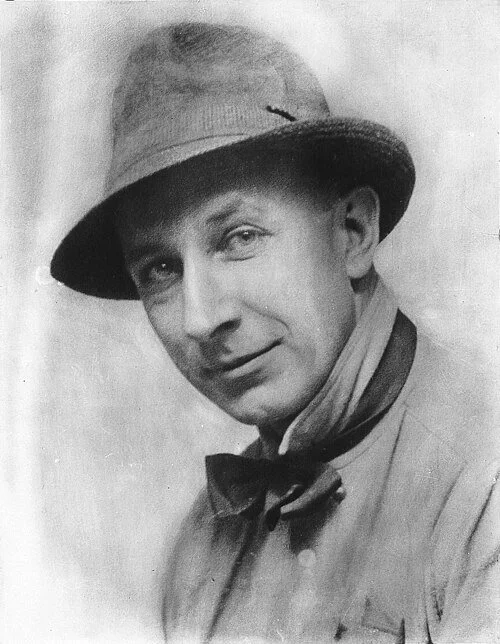
George Wesley Bellows was a central figure in early twentieth century American art, best understood within the broader cultural, social, and artistic transformations of his time. His work emerged during a period of rapid industrialization and urbanization in the United States, particularly in cities like New York City, where Bellows spent much of his career. This environment marked by immigration, economic inequality, and crowded living conditions shaped both his subject matter and his artistic approach. Bellows was closely associated with the Ashcan School, a group of artists who rejected the polished idealism of academic painting in favor of gritty, unvarnished depictions of everyday life. Influenced by his teacher Robert Henri, Bellows embraced the idea that art should reflect the realities of modern existence.
This meant turning his attention to subjects often ignored or dismissed by the art establishment: boxing matches, street scenes, construction sites, and the lives of working class people. The popularity of boxing in Bellows’ work, including paintings like Ringside Seats, can be understood in the context of the sport’s cultural significance at the time. Boxing was both controversial and widely popular, often associated with masculinity, immigration, and urban working class identity. By depicting these matches with such intensity, Bellows was not only capturing a spectacle but also engaging with broader questions about violence, entertainment, and social dynamics. His ringside scenes place viewers amid the crowd, implicating them in the collective fascination with physical struggle. Bellows’ career also coincided with the rise of modernism in art, yet his work occupies a unique position. While European artists were experimenting with abstraction, Bellows remained committed to representation. However, his loose brushwork, dramatic compositions, and emphasis on movement reveal an awareness of modernist concerns.
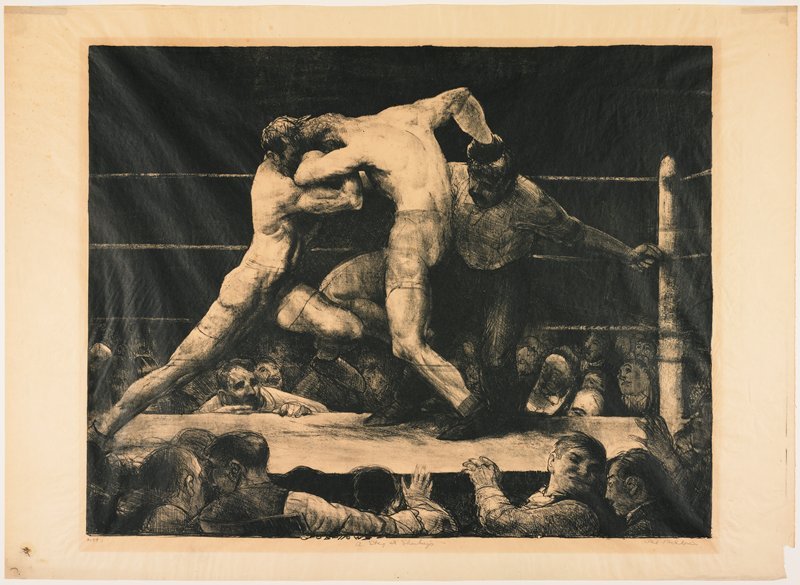
Rather than abandoning realism, he pushed it toward greater emotional and physical immediacy, creating images that feel both observed and intensely experienced. Historically, Bellows’ work reflects the tensions of the Progressive Era roughly 1890s–1920s, a time when Americans were grappling with issues such as labor rights, poverty, and social reform. His paintings do not offer direct political solutions, but they do expose the conditions and experiences of urban life, encouraging viewers to confront realities that were often overlooked. In this sense, his art can be seen as aligned with contemporary movements in journalism and literature that sought to reveal social truths. Additionally, Bellows’ interest in themes of conflict and physicality extended beyond boxing. His later works, including lithographs responding to World War I, show a growing engagement with international events and moral questions.
These images often depict violence in a more explicitly critical light, suggesting an evolution in how he approached the subject of human struggle. In context, Bellows stands as a bridge between nineteenth-century realism and twentieth century modernism. His work captures the energy, contradictions, and challenges of a rapidly changing America. By focusing on the immediacy of lived experience whether in the boxing ring or on the city streets he created a body of work that is both historically grounded and enduringly relevant.
