ANALYSIS
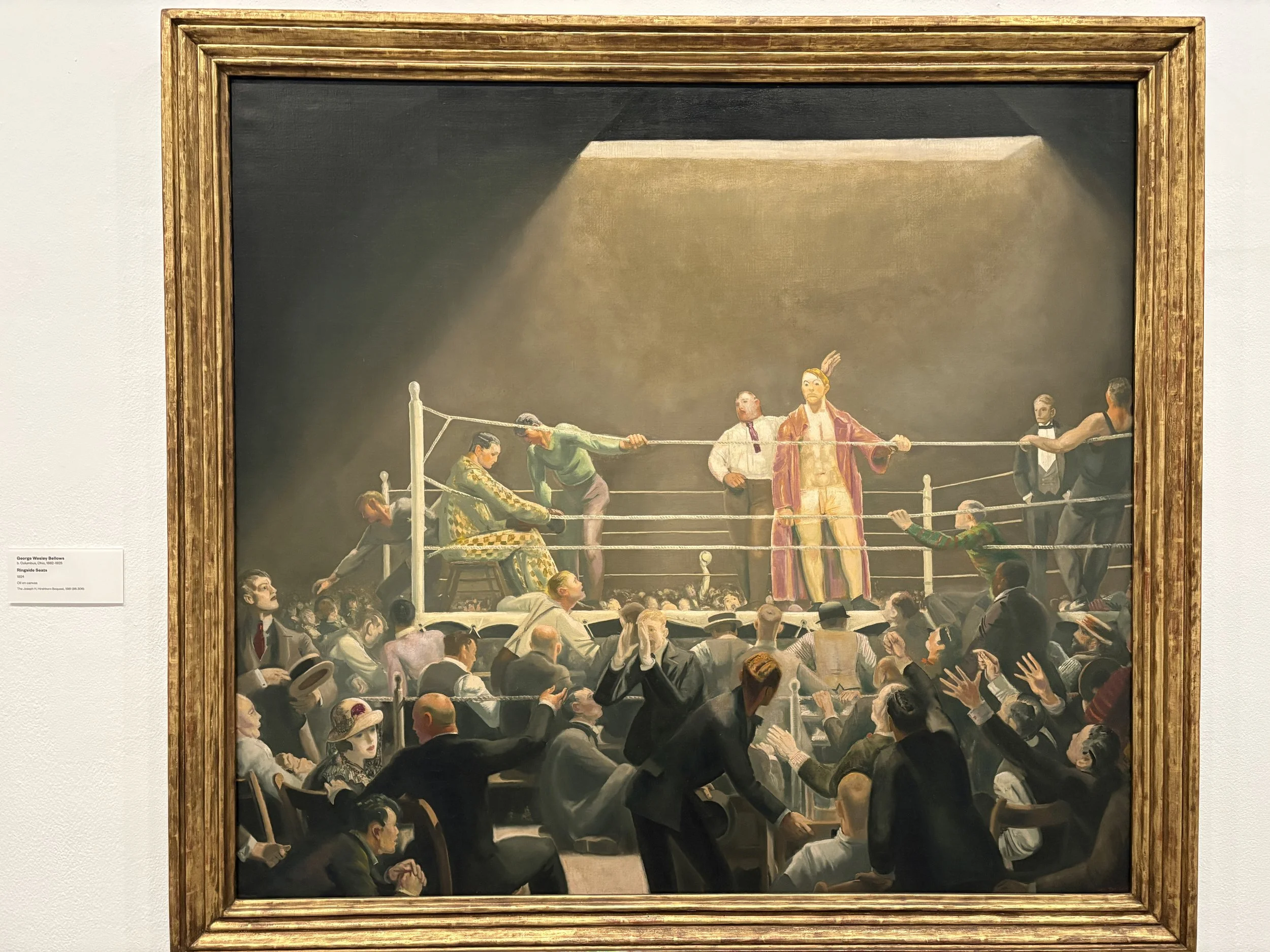
I find myself pressed tightly among the crowd in Ringside Seats by George Wesley Bellows, my view fixed on the violent spectacle unfolding just a few feet away. The ring feels almost too close, as though I could reach out and touch the ropes or feel the spray of sweat from the fighters. The two boxers are locked in motion, their bodies twisting and colliding under the harsh glare of the overhead lights. I can sense the force of each blow, even though I am only a spectator. Their muscles strain, their faces blur with effort, and their movements seem both frantic and deliberate, like a dance driven by instinct and survival.
The light is unforgiving. It pours down onto the fighters, illuminating their pale skin against the darker, indistinct mass of the crowd around me. Everything beyond the ring feels compressed and chaotic, but the center is impossibly sharp. My eyes are drawn again and again to the clash of bodies, to the way one fighter leans into the other, as if refusing to yield. The brightness makes the scene feel exposed, almost theatrical, as though this violence has been staged for us, the audience, to consume.
I become aware of the people surrounding me. Their faces are just as compelling as the fight itself. Some lean forward eagerly, their mouths open, their expressions electric with anticipation. Others seem tense, their brows furrowed, as if unsure whether to be thrilled or disturbed. I feel their presence pressing in on me, their energy feeding into the moment. It is impossible to remain detached here; the crowd pulls me in, making me part of something larger and more unsettling.
There is a rhythm to the scene and the shifting bodies, the flicker of movement, the surge of attention whenever a punch lands. I feel my own body responding, leaning forward, my gaze fixed, unable to look away. The fighters seem trapped in this circle of light, while we, the spectators, form a shadowy barrier around them. It is as if the ring is a stage and we are both audience and accomplice, drawn to the intensity even as it borders on brutality.
The brushstrokes themselves feel alive, rough and urgent, mirroring the chaos of the moment. Nothing is still. Even the edges of the figures seem to vibrate, as though the entire scene is trembling with energy. I don’t just see the fight, I feel it. The tension of the crowd, in the heat of the lights, in the relentless motion of the fighters. Standing there, I realize I am not simply observing a boxing match. I am caught in an experience that blurs the line between fascination and discomfort. I am aware of my own gaze, of my own participation in this spectacle. The painting does not let me remain distant. Instead, it places me here, at ringside, confronting both the violence in the ring and the strange pull it exerts on all of us.